


Primary tabs
You don't need to be an ALA Member to purchase from the ALA Store, but you'll be asked to create an online account/profile during checkout to proceed. This Web Account is for both Members and non-Members. Note that your ALA Member discount will be applied at the final step of the checkout process.
If you are Tax-Exempt, please verify that your account is currently set up as exempt before placing your order, as our new fulfillment center will need current documentation. Learn how to verify here.
- Description
- Table of Contents
- About the authors
- Reviews
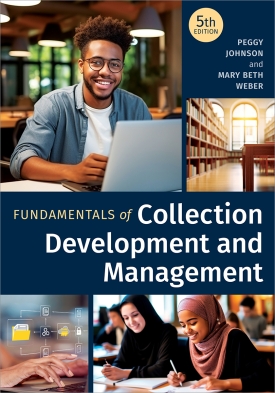
LIS students and practitioners alike will find this top-to-bottom guide to collection development and management a must-have resource at every stage of their career.
A "remarkable achievement" (Technical Services Quarterly), this benchmark text serves as the perfect guide for beginners and a quick reference tool for seasoned professionals. For the new fifth edition, expert instructor and librarian Johnson is joined by technical services expert Weber. Complete with refreshed case studies exploring the issues and suggestions for further reading, each chapter provides in-depth coverage of one aspect of collection development and management. Readers will gain a thorough understanding of
- traditional management topics such as organization of the collection, staffing, planning, and policymaking;
- the continuing relevance and importance of the discipline in an increasingly digital environment;
- open access, the Big Ten Open Books collection, and moving toward a digital library ownership model;
- e-book lending, including purchasing models (PDA, DDA, EBA) and controlled digital lending;
- collaborative collection development and management;
- licenses, negotiation, contracts, maintaining productive relationships with vendors and publishers, and other important purchasing and budgeting topics;
- self-published books and their path into library collections;
- collection analysis and weeding, including both print and e-resources;
- timely issues such as the ways in which collecting practices have changed post-pandemic, the evolving needs and expectations of library users, diversity in library collections, and ensuring accessibility, all illustrated using updated examples and data; and
- marketing, liaison activities, and outreach, through coverage expanded for this edition.
Examination copies are available for instructors who are interested in adopting this title for course use. An e-book edition of the text will be available shortly after the print edition is published.
List of Figures
Preface to the Fifth Edition
Acknowledgments
1 Introduction to Collection Development and Management
Components of Collection Development and Management
Historical Overview
Theories of Selection
Future of Collection Development and Management
Notes
Suggested Readings
2 Organizational Models, Staffing, and Responsibilities
Collection Management and Development Responsibilities
Assignment of Responsibilities
Learning after School
Performance Evaluation
Organizational Models
Ethical Issues
Case Study
Notes
Suggested Readings
3 Planning, Policy, and Budgets
Planning in Libraries
Planning Models
Environmental Scanning
Why Undertake Formal Planning?
Collection Development Policy Statements
Writing the Collection Development Policy Statement
Budgeting and Finance
Case Study
Notes
Suggested Readings
4 Developing Collections
The Universe of Published Materials
The Selection Process
Case Study
Notes
Suggested Readings
5 Vendor Relations, Negotiation, and Contracts
Overview
Vendor Relations
Negotiation
Contracts
Case Study
Notes
Suggested Readings
6 Managing Collections
Weeding
Storage
Preservation and Conservation
Review and Cancellation of Continuing Resources
Collection Protection and Security
Case Study
Notes
Suggested Readings
7 Marketing, Liaison Activities, and Outreach
Understanding Marketing
Marketing Concepts
Managing the Marketing Cycle
Liaison and Outreach Activities
Social Media
Case Study
Notes
Suggested Readings
8 Collection Analysis, Accountability, and Demonstrating Value
Collection Analysis as a Management Tool
Historical Overview of Collection Analysis
Approaches to Collection Analysis
Electronic Resources and Collection Analysis
Collection-Based Analysis Methods
Use- and User-Centered Analysis Methods
Cost-Benefit Analysis, Social Return on Investment, and Balanced Scorecards
Conducting the Analysis and Preparing a Collection Analysis Report
Case Study
Notes
Suggested Readings
9 Collaborative Collection Development and Management
Overview
Resource Sharing
Bibliographic Access
Coordinated or Collaborative Collection Building and Management
Infrastructure for Cooperative and Collaborative Collection Development and Management
Attributes of Successful Consortia
Challenges to Collaborative Collection Development and Management
Evaluating Collaborative and Cooperative Collection Development and Management
Case Study
Notes
Suggested Readings
Appendixes
- Appendix A Professional Resources for Collection Development and Management
- Appendix B Selection Aids
About the Authors
Index
Peggy Johnson
Peggy Johnson is a frequent speaker and trainer on collection development and management. She has published several books, including ALA Editions’ Developing and Managing Electronic Collections: The Essentials, and numerous journal articles. She edited the peer-reviewed journal Library Resources & Technical Services for more than nine years and continues to edit Technicalities: Information Forum for the Technical Services Professional. Prior to retiring from the University of Minnesota Libraries, she served as associate university librarian. During more than thirty years at the University of Minnesota, her responsibilities focused on collection development and management, technical services, institutional planning, grants management, and budgeting. A past president of the Association for Library Collections and Technical Services (ALCTS), she received the ALCTS Ross Atkinson Lifetime Achievement Award in 2009. Peggy has consulted on library development in Uganda, Rwanda, Senegal, Morocco, and China.
Mary Beth Weber
Mary Beth Weber has worked in library technical services in academic libraries for over thirty years. She has held various technical services positions, and is an expert on cataloging nonprint materials, acquisitions workflows, and non-MARC metadata for digital collections. She also has extensive managerial experience. Weber has authored numerous books, including Virtual Technical Services: A Manual and Rethinking Library Technical Services: Redefining Our Profession for the Future. She has given presentations on cataloging, mentoring, and publishing for various organizations. She chaired Rutgers University Libraries’ Faculty Mentoring Program Committee for two years, and participated in ALCTS’ inaugural mentoring program. Weber is an active member of Core: Leadership, Infrastructure, Futures, a division of ALA. She served as editor-in-chief of Library Resources and Technical Services (LRTS) for nine years and helped transition the journal from ALCTS to Core. Weber was awarded the ALCTS Presidential Citation in 2011 for her service as the ALCTS Newsletter Editor. She received the ALCTS Honors award in 2015 for her contributions as LRTS Editor. Weber is currently the head of central technical services at Rutgers University Libraries and oversees resource description (MARC and non-MARC) for all four of Rutgers’ campuses.
"Thoroughly updated ... The chapter on vendor relations, negotiation, and contracts is a standout, providing invaluable information on understanding contracts and licenses in an environment that has seen enormous change due to the proliferation of digital resources. Librarians navigating the sometimes-bewildering digital landscape should appreciate the authors’ discussion of ebook lending, purchasing models, collaborative collection development, and open access."
— Library Journal (starred review)
"The quintessential textbook for Librarianship as an ongoing profession. Throughout this text, there are numerous notes and suggested readings that make the authors experts in this genre."
— Journal of Hospital Librarianship
"Authoritative and comprehensive ... In my professional opinion, as a librarian with over thirty years of experience in all areas of technical services and collection management, this is one of the most thorough and reliable works available on the topic."
— Technical Services Quarterly
"Serves as an excellent guide for the tools of the trade, such as writing a collection development policy or managing the weeding process. It contains many useful descriptions of process and examples for students and practitioners to draw upon ... This book remains an important guide to collection development and management activities and is recommended to both students and practitioners."
— Journal of the Australian Library and Information Association
Praise for previous editions:
"The information is well researched, logically arranged, and suitable as a guide for beginners and a quick reference tool for seasoned professionals."
— ARBA
"A remarkable achievement ... An excellent resource for all librarians, from those just getting started in collection development to the most experienced practitioner."
— Technical Services Quarterly