
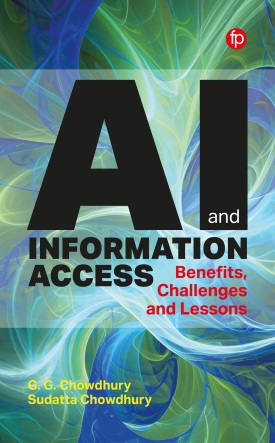


AI and Information Access: Benefits, Challenges and Lessons

Customers outside of North America (USA and Canada) should contact Facet Publishing for purchasing information.

ALA Member
$66.59
Price
$73.99
Item Number
978-1-78330-772-2
Published
2025
Publisher
Facet Publishing, UK
Pages
264
Width
6"
Height
9"
Format
Softcover
Samples
Read a sample of this book now!
308.62 KB • pdf • Download

Primary tabs

You don't need to be an ALA Member to purchase from the ALA Store, but you'll be asked to create an online account/profile during checkout to proceed. This Web Account is for both Members and non-Members. Note that your ALA Member discount will be applied at the final step of the checkout process.

If you are Tax-Exempt, please verify that your account is currently set up as exempt before placing your order, as our new fulfillment center will need current documentation. Learn how to verify here.

  • Description
  • Table of Contents
  • About the authors
  • Reviews

This book is tailored for the knowledge sector, from LIS professionals to students and academics. It's a perfect title for those seeking to understand Generative AI and how it applies in their context.

Libraries and information services are constantly evolving and adapting to the capacity and capabilities offered by emerging technologies. With the emergence of Generative AI, the information sector wonders how it will impact information users and professionals. The book examines this vital question by first raising evidence-based questions around user interactions with AI and its efficacy in providing responses that are relevant and suitable for specific user needs and contexts. Through the critical analysis of these case studies, the book discusses whether and how the conventional models of information search process, information seeking and retrieval, are applicable to explain the user interactions with the Gen AI tools for information access. This approach to AI and information explores

  • the impact of AI tools on information by changing user behavior, shifting the gap in user access and impending users to find the best data and being critical;
  • how libraries and database search services adapt these tools to improve access to information and data;
  • the ways in which the use of these tools could generate new knowledge in information science, seeking and retrieval research, and education; and
  • how these tools can be trained to best fulfil the user's needs and context.

While exploring the implications of AI for the overall library and database services, the book will aim to portray the overall picture of applications of Generative AI in the information science field.

Introduction

1. Generative AI and Access to Information

2. Information Access: Tools and Processes

3. Information Seeking

4. Gen AI for Everyday Life Information

5. Gen AI for Scholarly Information

6. Gen AI for Research Information

7. Gen AI and the Information World

8. Gen AI and Information Seeking: Some Lessons

9. Gen AI for Information Access: Teaching, Research and Professional Practices

References

Index

G.G. Chowdhury

G. G. Chowdhury is a Professor of Information Science in the Department of Computer and Information Sciences at the University of Strathclyde, UK. Previously, he had held several senior academic positions including Professor and Head of Mathematics and Information Sciences, as the Head of iSchool at Northumbria University and as a Professor and Director of Information and Knowledge Management at the University of Technology Sydney. Professor Chowdhury is a world-leading expert in digital libraries, cultural information management and sustainable information systems and services. He has published 16 books and over 160 research papers and has previously served as the European and Global Chair of the iSchools organization.

Sudatta Chowdhury

Sudatta Chowdhury is Research Associate in the Department of Computer and Information Sciences at the University of Strathclyde in Glasgow, UK. She had held numerous academic and research positions at universities in the UK, Singapore and Australia. Sudatta's research focuses on information seeking behavior and human-centred challenges for access to information including the digital divide, and digital and information skills. She has co-authored five book, several journal and conference papers and book chapters.

Have you read this book? Leave a review!